
How Our Ratings Work
Tip
New to the E-Z Win® Form?
Our proprietary rating system is the engine behind the E-Z Win® Form. It analyzes recent race history, class, and surface aptitude to produce a numerical rating for every horse — then groups them into color-coded tiers so you can quickly identify contenders. This page explains how those numbers work and how to get the most out of them.
Rating Basics
Every rated horse receives a numerical rating displayed in the stats area of their entry card, colored to match their tier. Ratings are length-based — each point equals one length, which is roughly one-fifth of a second. If Horse A rates a 55 and Horse B rates a 52, our analysis says Horse A is 3 lengths better, all else being equal.
This scale makes ratings intuitive: you can quickly gauge how close or far apart horses are. A one-point gap is a neck; a five-point gap is a serious advantage.
How Dirt Ratings Work
On dirt, each horse receives two ratings that are averaged together to produce the final ranking value:
Recent Rating
Our evaluation of the horse based on their most recent applicable dirt race. It reflects current form — what the horse actually did last time out on this surface.
You may see + symbols next to this rating:
- One plus (+) means the horse has a reason to improve off that race (equivalent to the Should Improve icon on the form)
- Two pluses (++) means there are multiple reasons to expect improvement — such as a class drop combined with a favorable surface switch, or a first-race-back effort plus the addition of Lasix
Composite Rating
A broader evaluation where we analyze up to 4 recent applicable races and take the median. The Composite smooths out single-race anomalies — a bad trip, a troubled start, or an unusually fast or slow pace that inflated or deflated one result. It gives you a truer picture of the horse's baseline ability.
The Final Number
The average of the Recent and Composite ratings is the value used to rank horses and assign tiers. This balances recency (what did the horse just do?) with consistency (what does the horse typically do?).
For example, a horse showing 61/63 has a Recent Rating of 61 and a Composite of 63, giving it a ranking value of 62.
How Turf Ratings Work
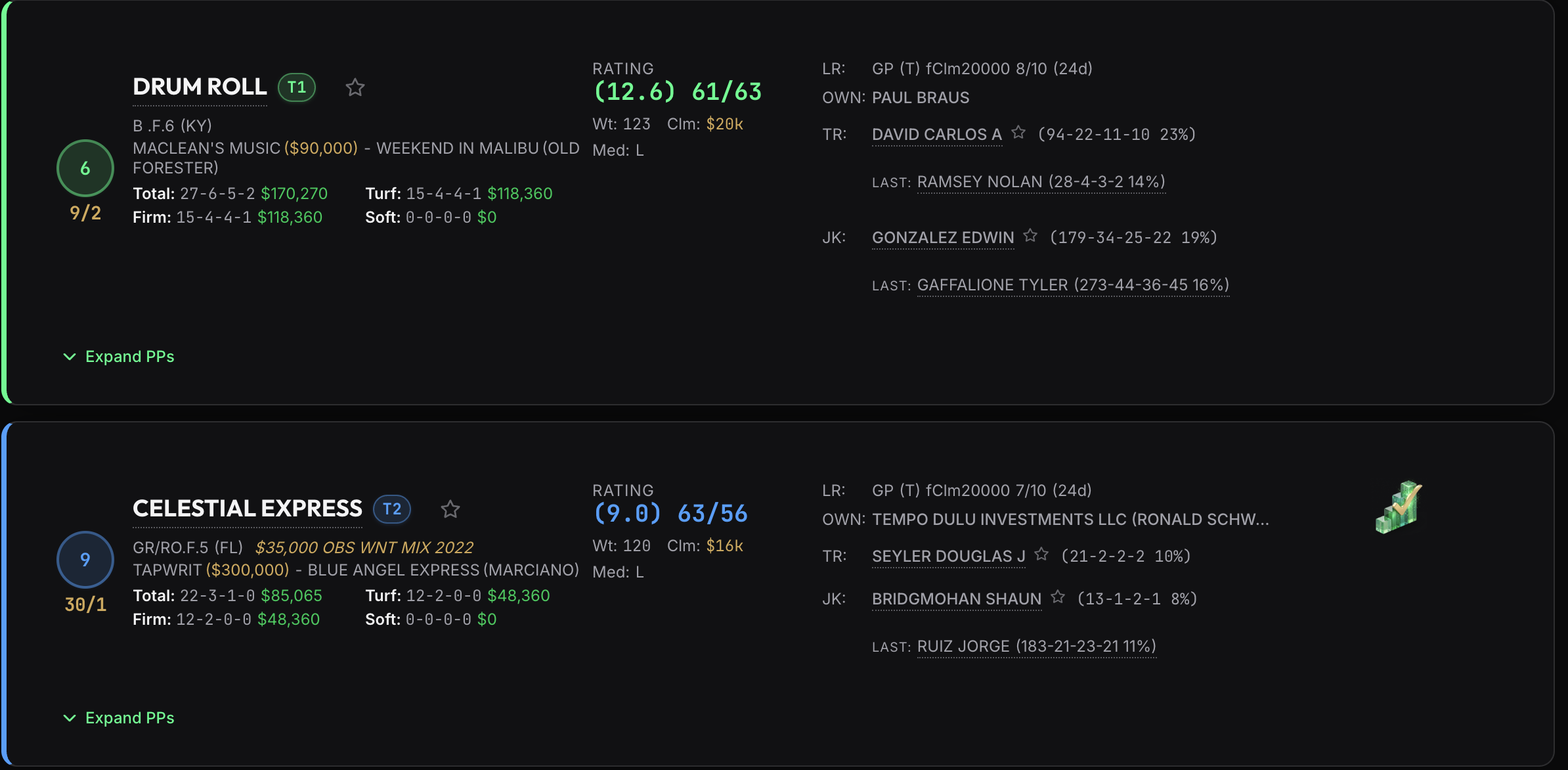
Turf racing adds a critical dimension: class matters more on grass. Dirt races often come down to raw speed, but turf races reward tactical ability, pedigree, and experience at the right level. Our turf ratings reflect this.
For turf races, each horse receives three ratings:
Turf Class Rating
Shown first, in parentheses — for example, (12.6). This evaluates how "classy" a horse is on the turf based on:
- The types of turf races the horse has competed in (stakes, allowance, claiming, maiden)
- How successful the horse has been in those races
We have determined that this is the most important rating for turf races, and it is the primary factor used to assign tiers on grass.
Recent Rating & Composite Rating
These work identically to dirt — one based on the most recent applicable turf race, one based on the median of up to 4 recent turf races.
How They Combine
On turf, horses are primarily tiered on the Turf Class rating. Within each tier, a secondary sort uses the Recent and Composite ratings to separate horses of similar class by raw performance ability. This two-level approach reflects how turf races actually play out: class gets you into contention, and ability separates the contenders.
What the Numbers Are Telling You
The ratings aren't just for ranking horses — the relationships between them tell a story.
Discrepancies Between Recent and Composite
Pay attention when the Recent and Composite ratings diverge significantly. The gap itself is a handicapping signal:
- High Recent, Low Composite — The horse ran much better last time than it typically does. This could mean the horse has genuinely improved (look for a reason: new trainer, equipment change, class drop, surface switch). Or it could mean the last race was a fluke — a speed-favoring track bias, a weak field, or a perfect trip it's unlikely to repeat. Check the trip comment and field quality before trusting the jump.
- Low Recent, High Composite — The horse ran worse last time than its history suggests. This is often a horse worth a second look. A bad trip, a poor post position, an unsuitable surface, or a race off a layoff can all produce a dud. If the Composite says this horse is typically much better and you can identify a reason for the bad last race, you may be catching a good horse at inflated odds.
- Close together — The horse is running consistently. What you see is what you get — fewer surprises, but also fewer opportunities to find value.
Rating Trends in Past Performances
Expand any horse's past performances and you'll see a rating column on the far left — our rating for each past race. This is one of the most useful ways to verify the story the numbers are telling:
- Improving ratings race over race confirm a horse on the upswing — that high Recent Rating is the real deal, not a fluke
- Declining ratings may indicate a horse that is tailing off — that high Composite may be propped up by older, better races
- A single outlier in a string of consistent ratings often points to a troubled trip or an unusual pace scenario — check the trip comment for that race
Color Coding
The past performance ratings are color-coded to show which races feed into today's numbers:
- Blue — The race used for the Recent Rating
- Purple — The races used for the Composite Rating
- Muted — Older or less relevant races that aren't part of today's calculation
This lets you see exactly which races are driving the horse's current rating and judge for yourself whether those races are representative.
How Surface & Condition Changes Affect Ratings
Ratings are not static — they respond to the surface and condition of the track.
Surface Matters
A horse's dirt rating is calculated from its dirt races. Its turf rating is calculated from its turf races. Switch the surface selector on the form from Turf to Dirt, and you may see a completely different set of contenders. A horse that dominates on dirt may have limited or weak turf form, while a turf specialist buried in the dirt rankings could jump to the top tier on grass.
This is especially important when a turf race comes off the grass — a common occurrence after rain. The form automatically recalculates ratings using dirt history, and the rankings can shift dramatically. Horses that were afterthoughts on turf can suddenly become contenders on dirt, and vice versa.
Condition Matters
Track condition (Fast, Good, Muddy, Sloppy, Firm, Yielding, etc.) also changes the analysis. Some horses thrive in the mud; others fall apart. When conditions change, our ratings adjust to weight races run under similar conditions more heavily.
Real-Time Updates
On live race days, the form automatically picks up surface and condition changes from the track and recalculates ratings — no action needed on your part. You can also use the Surface & Condition selectors to preview "what if" scenarios, like checking how the field would rate if rain turns the track Sloppy later in the day.
Unrated Horses
Some horses appear as Unrated (Grey) on the form. This typically means there is insufficient data to generate a reliable rating — for example, a foreign shipper with no domestic form, or a first-time starter with no race history at all.
Warning
Unrated does NOT mean the horse is bad. It means we don't have enough data to rate them. Examine these horses manually — check workouts, pedigree, trainer stats, and connections before dismissing them.
Tips for Using Ratings
- Don't fixate on a single number. The tier is often more useful than the exact rating. Horses within the same tier are typically close in ability — separating them is where your own handicapping comes in.
- Watch for the + indicators. A horse rated 48+ may outrun a horse rated 50 if those improvement factors are real. Multiple pluses (++) are an even stronger signal.
- Use the surface/condition selectors. Before a live race day, check how the field looks under different conditions. If rain is in the forecast, preview Muddy or Sloppy to see which horses benefit — and check turf races on the Dirt surface to see how the field reshapes if the race comes off the grass.
- Check the past performance trend. A horse rated 52 today who has been steadily climbing from 45 → 48 → 50 → 52 is more dangerous than one who has been flat or declining.
- Turf class trumps speed. On grass, trust the Turf Class rating as the primary separator. A classier horse with slightly lower speed figures will often find a way to win.
- Respect the Unrated. Don't automatically toss grey horses — some of the biggest payoffs come from unrated horses that the public ignores.
Related
- How to Read the E-Z Win® Form — A visual walkthrough of every section of the form
- E-Z Win® Sample Form — See the form in action with a live example